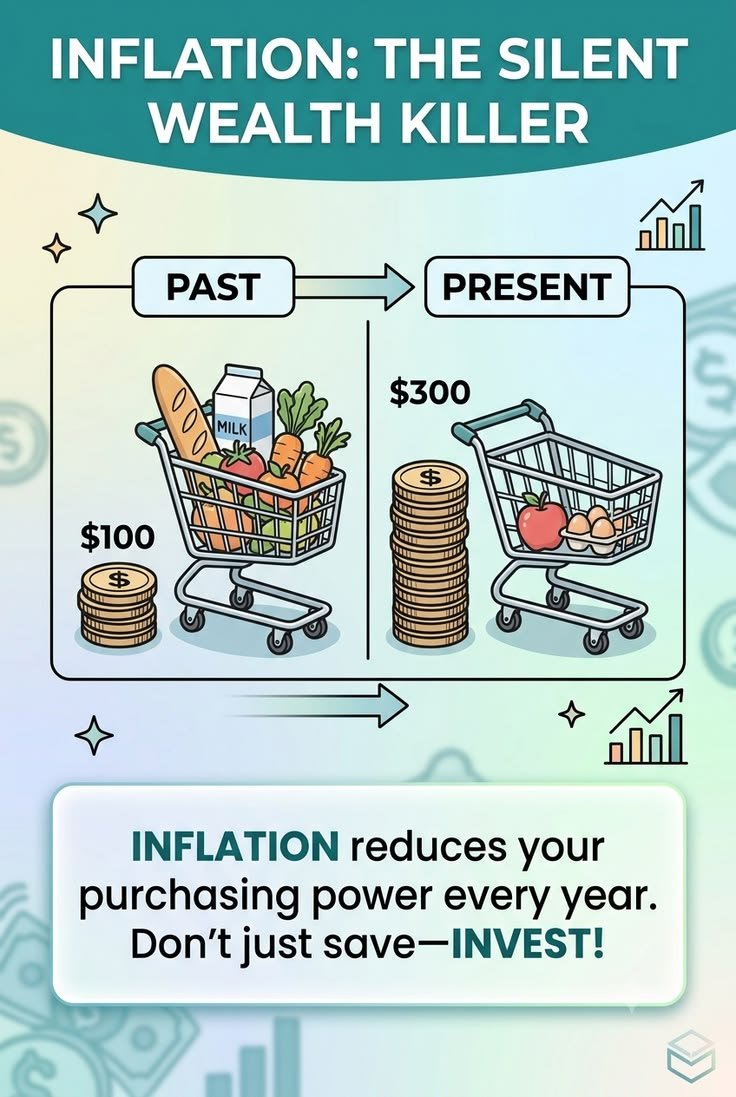
Inflation is one of the biggest challenges people face when trying to build a secure financial future. You may work hard, earn money, and consistently put some of your income into savings, only to discover that the same amount of money cannot buy as much as it could a year ago. Groceries become more expensive, rent increases, transportation costs rise, and everyday necessities gradually take a bigger portion of your income.
This is the reality of inflation. It quietly reduces the purchasing power of your money, making it harder to achieve financial goals even when your savings account balance continues to grow.
Imagine saving $10,000 today. Although that amount will still appear as $10,000 in your bank account next year, its purchasing power may be lower if prices have increased. In other words, your money has not disappeared, but it may no longer provide the same financial value.
The good news is that you do not have to watch inflation weaken your savings without taking action. With the right financial habits, thoughtful planning, and smart investment decisions, you can protect your money and improve your long-term financial stability.
Whether you are saving for a home, preparing for retirement, building an emergency fund, or simply trying to become financially independent, understanding how to protect your savings against inflation is essential.
Here are 15 smart and practical strategies that can help you preserve your money, strengthen your financial position, and build a more secure future.
1. Keep Your Money in High-Yield Savings Accounts
One of the simplest ways to protect your savings against inflation is to choose a high-yield savings account instead of leaving all your money in a traditional account that pays little or no interest.
Many traditional savings accounts offer relatively low interest rates. When inflation rises faster than the interest your bank pays, your money gradually loses purchasing power.
High-yield savings accounts generally provide more competitive interest rates, allowing your money to earn more while remaining accessible.
For example, imagine you have $10,000 in savings. If your account earns 4% interest annually, you could earn approximately $400 in interest over one year before taxes, assuming the rate remains unchanged.
Although this may not completely overcome inflation, it is generally better than allowing your savings to earn almost nothing.
Before opening an account, compare interest rates, fees, withdrawal conditions, and deposit insurance. In the United States, make sure the institution offers appropriate FDIC or NCUA insurance.
2. Invest in Treasury Inflation-Protected Securities (TIPS)
Treasury Inflation-Protected Securities, commonly known as TIPS, are government-backed investments designed to help protect investors against inflation.
Unlike traditional bonds, TIPS adjust their principal value based on changes in the Consumer Price Index (CPI).
When inflation increases, the principal value generally rises. When inflation falls, the principal value can decrease, although at maturity investors receive at least the original principal amount under the security’s terms.
TIPS can be useful for people who want to protect part of their long-term savings from rising prices without taking on the same level of risk associated with stocks.
You can purchase TIPS through TreasuryDirect or through certain brokerage accounts.
However, it is important to understand that TIPS are not completely risk-free. Their market prices can fluctuate when sold before maturity, and their returns depend on purchase price, interest rates, and inflation.
3. Avoid Keeping All Your Savings in Cash
Keeping some cash is important because emergencies can happen without warning. However, keeping every dollar in cash for many years may expose your savings to inflation.
Cash provides convenience and stability, but it generally does not offer significant long-term growth.
For instance, imagine someone saves $30,000 and keeps the entire amount in an account that earns almost no interest. If prices continue increasing, that person may eventually discover that the savings cannot cover as many expenses as before.
A smarter approach is to divide your money according to its purpose.
Keep emergency savings in an accessible account, reserve money for upcoming expenses, and consider investing money that you will not need for several years.
The goal is not to eliminate cash completely. It is to ensure that your money is positioned appropriately for your financial needs.
4. Invest in a Diversified Stock Portfolio
Investing in stocks can be an effective long-term strategy for protecting and growing your wealth.
Companies can sometimes increase their prices as production costs rise, allowing their revenues and profits to grow alongside inflation. Over long periods, stock investments have historically provided returns that have exceeded inflation, although this is never guaranteed.
However, investing in individual companies can expose you to unnecessary risks.
One practical solution is diversification.
Instead of putting all your money into one company, consider spreading your investments across different industries, businesses, and geographical markets.
Broad-market index funds and exchange-traded funds (ETFs) can make diversification easier for beginners.
Remember that stock markets experience periods of decline. Never invest money you need immediately, and make sure your investment choices match your financial goals and risk tolerance.
5. Build an Emergency Fund Before Making Risky Investments
Inflation can make financial emergencies even more difficult because unexpected expenses become more expensive over time.
Imagine losing your job while your rent, groceries, electricity, and transportation costs continue increasing. Without emergency savings, you might be forced to borrow money, use credit cards, or sell investments at an unfavorable time.
An emergency fund provides financial protection during difficult periods.
A reasonable starting goal is to save $1,000, then gradually work toward covering three to six months of essential living expenses. Your ideal amount may be higher if your income is irregular or your financial responsibilities are significant.
Keep this money somewhere safe and accessible, such as an insured high-yield savings account.
An emergency fund may not generate substantial investment returns, but its real value is the financial protection and peace of mind it provides.
6. Consider Investing in Real Estate
Real estate is another investment option that some people use to protect their wealth against inflation.
Property values and rental income can increase over time, although neither is guaranteed. In certain markets, property owners may benefit when housing demand rises and replacement costs become more expensive.
For example, someone who purchases a rental property may earn income from tenants while potentially benefiting from long-term property appreciation.
However, real estate requires careful planning.
Property taxes, maintenance, insurance, mortgage payments, vacancies, and unexpected repairs can significantly reduce profits.
You do not necessarily need to purchase an entire property to gain real estate exposure. Real estate investment trusts (REITs) allow individuals to invest in property-related businesses through publicly traded securities.
Always evaluate the risks, costs, and liquidity before investing.
7. Reduce Unnecessary Spending and Control Your Lifestyle
One of the most powerful ways to protect your savings against inflation is to become more intentional about how you spend money.
When prices increase, it is tempting to continue living exactly as before and simply accept higher expenses. Unfortunately, this approach can gradually destroy your ability to save.
Start by reviewing your monthly spending.
Look at subscriptions, restaurant purchases, entertainment, transportation, and other expenses that may not be essential.
You do not have to eliminate everything you enjoy. Instead, identify areas where you can spend less without making your life unnecessarily uncomfortable.
For example, preparing meals at home more frequently, comparing insurance prices, and canceling unused subscriptions can free up money for savings.
Financial success is not always about earning more. Sometimes, it begins with learning how to keep more of what you already earn.
8. Increase Your Income Through Additional Skills
When inflation increases the cost of living, depending on a single source of income can become financially challenging.
One way to strengthen your financial position is to increase your earning potential.
Consider developing skills that are valuable in the modern job market, such as digital marketing, programming, financial analysis, graphic design, project management, or professional communication.
You can also explore freelancing, consulting, tutoring, or starting a small side business.
The advantage of increasing your income is that it gives you more flexibility.
Rather than using every additional dollar to cover rising expenses, you can direct part of your increased earnings toward emergency savings, investments, and debt repayment.
Your skills are valuable financial assets because they can help you create opportunities beyond your regular paycheck.
9. Pay Off High-Interest Debt as Quickly as Possible
Inflation can create pressure on household budgets, especially when people are already carrying expensive debt.
Credit cards and certain personal loans can charge interest rates that make financial progress extremely difficult.
Imagine carrying a $5,000 credit card balance with a 24% annual percentage rate. If you make only minimum payments, interest can consume a significant portion of your money.
Paying down high-interest debt can provide a meaningful financial benefit because it reduces the amount of interest you would otherwise pay.
Start by listing your outstanding debts, interest rates, and minimum monthly payments.
Then consider using either the debt avalanche method, which prioritizes the highest-interest debt, or the debt snowball method, which prioritizes the smallest balance.
Reducing expensive debt creates more room in your budget and makes it easier to protect your savings.
10. Consider Gold as a Small Part of Your Investment Strategy
Gold has been used as a store of value for centuries, and some investors consider it when trying to protect wealth during periods of economic uncertainty.
Unlike paper currencies, gold is a physical asset with a limited supply. Its price can sometimes rise during periods of financial instability or concerns about inflation.
However, gold is not a guaranteed inflation hedge.
Its price can fluctuate significantly, and it does not generate interest, dividends, or rental income.
If you decide to invest in gold, consider keeping it as a small part of a diversified portfolio rather than placing all your savings into it.
You should also understand the costs associated with purchasing, storing, and selling physical gold.
11. Review Your Financial Plan Regularly
A financial plan that worked two years ago may no longer be suitable when prices, income, and personal responsibilities change.
Inflation makes regular financial reviews even more important.
Set aside time every month or quarter to examine your savings, spending, investments, debt, and financial goals.
Ask yourself important questions:
- Are my savings growing at a reasonable rate?
- Have my monthly expenses increased?
- Am I saving enough for emergencies?
- Are my investments still aligned with my goals?
- Am I carrying unnecessary debt?
These simple questions can help you recognize financial problems before they become overwhelming.
You do not need to be a financial expert to manage your money effectively. Consistency and awareness can make a significant difference.
12. Take Advantage of Retirement Accounts
Retirement accounts can help protect your long-term financial future while offering potential tax advantages.
In the United States, options such as 401(k) plans and Individual Retirement Accounts (IRAs) allow individuals to invest for retirement.
Depending on the account type, contributions and investment growth may receive favorable tax treatment.
For example, traditional retirement accounts generally offer tax-deferred growth, while qualified Roth withdrawals can be tax-free.
Some employers also match a portion of employee 401(k) contributions. Taking advantage of an available employer match can provide an additional benefit toward retirement savings.
However, retirement accounts have contribution limits, withdrawal rules, and possible penalties.
Choose investments that match your retirement timeline and risk tolerance. A diversified portfolio can help support long-term growth, although investment returns are never guaranteed.
13. Avoid Emotional Financial Decisions
Inflation can create fear and uncertainty. When people notice their savings losing purchasing power, they may feel pressured to make quick financial decisions.
Some rush into investments they do not understand. Others sell their investments when markets decline or move all their money into assets that have recently increased in price.
These emotional decisions can create unnecessary financial losses.
A better approach is to make decisions based on research, realistic expectations, and a clear financial plan.
Before investing, understand what you are purchasing, the risks involved, the fees you will pay, and how the investment supports your long-term goals.
Remember that building wealth is not a race. You do not need to chase every financial opportunity to achieve financial security.
Patience, discipline, and consistency are often more valuable than trying to predict every market movement.
14. Compare Prices and Become a Smarter Consumer
Inflation affects almost every part of everyday life, but consumers can reduce its impact by becoming more strategic with their purchases.
Instead of automatically buying products from familiar brands, compare prices and look for alternatives that offer similar quality.
For groceries, consider purchasing frequently used items in bulk when the overall price is genuinely lower.
For insurance, utilities, internet services, and other recurring expenses, compare providers regularly.
You can also plan your shopping trips, use legitimate discounts, and avoid impulse purchases.
For example, purchasing groceries with a weekly shopping list can help prevent unnecessary spending and reduce food waste.
Small savings may seem insignificant individually, but they can become substantial over an entire year.
The money you save can be redirected toward your emergency fund, investments, or other important financial goals.
15. Develop a Long-Term Wealth-Building Mindset
Perhaps the most important way to protect your savings against inflation is to develop a mindset focused on long-term financial security.
Many people concentrate only on how much money they have today. However, financial success also depends on how effectively they prepare for tomorrow.
Building wealth requires patience, discipline, education, and consistent action.
You do not need to become wealthy overnight. You can begin with small financial improvements, such as saving a percentage of your income, reducing unnecessary expenses, paying off expensive debt, and investing regularly.
Over time, these decisions can create meaningful progress.
Understand that inflation will not disappear simply because you save more money. However, you can improve your ability to respond to rising prices by building stronger financial habits and making informed decisions.
Your goal should not simply be to accumulate money. It should be to build a financial foundation that can support your lifestyle, protect your family, and give you more freedom to make important life decisions.
Common Mistakes to Avoid When Protecting Your Savings Against Inflation
Even when people understand inflation, they sometimes make financial decisions that weaken their savings instead of protecting them.
Here are some mistakes worth avoiding:
- Keeping all your money in a low-interest account: Your savings may lose purchasing power when inflation exceeds the interest you earn.
- Investing without understanding the risks: Never put your money into an investment simply because someone promises high returns.
- Ignoring high-interest debt: Expensive debt can consume money that could otherwise support your financial goals.
- Following financial trends blindly: An investment that works for someone else may not be appropriate for your situation.
- Failing to maintain emergency savings: Unexpected expenses can force you to sell investments or borrow money.
- Waiting too long to start investing: Delaying long-term financial planning can reduce the time available for potential investment growth.
Avoiding these mistakes can help you make more thoughtful financial decisions and maintain greater control over your money.
Conclusion: Protect Your Savings Today for a Stronger Financial Tomorrow
Inflation is a financial reality that affects individuals, families, businesses, and entire economies. Although you cannot control rising prices, you can control many of the decisions that determine how well your money performs over time.
Protecting your savings requires more than simply putting money into a bank account and hoping it will be enough in the future. It requires understanding how inflation works, choosing suitable savings options, managing debt, investing wisely, controlling spending, and developing financial habits that support long-term growth.
The 15 strategies discussed in this article provide a practical starting point. You can begin by opening a competitive savings account, building an emergency fund, reviewing your expenses, and learning about investments that match your financial goals.
Most importantly, do not underestimate the power of small financial decisions. Saving an additional amount every month, avoiding unnecessary debt, or investing consistently may seem like a modest achievement today, but these actions can contribute to a stronger financial future.
Your money represents your hard work, time, and sacrifices. Protecting it should be a priority, not an afterthought. Start making smarter financial decisions today so that inflation does not determine what your future can afford.
