Building long-term wealth is not always about earning a huge salary, owning an expensive business, or making risky investments. Sometimes, the secret to financial success begins with something much simpler: learning how to manage the money you already earn.
Many people work hard every month, receive their salaries, pay their bills, purchase groceries, take care of family responsibilities, and cover other expenses. Before they realize it, another month has passed, and very little money remains in their bank accounts. This cycle can become frustrating, especially when someone wants to save, invest, buy a home, start a business, or enjoy a financially comfortable retirement.
The good news is that you do not need to become wealthy overnight to build a better financial future. Your monthly salary can become a powerful tool for creating long-term wealth when you develop the right habits, make thoughtful financial decisions, and remain consistent with your money.
Whether you earn a small salary or have a comfortable income, the principles of wealth building remain surprisingly similar. Spend wisely, save consistently, invest patiently, avoid unnecessary debt, and make your money work toward your future goals.
Here are 15 smart and practical ways to turn your monthly salary into long-term wealth.
1. Create a Monthly Budget That Gives Every Dollar a Purpose
One of the most important steps toward building wealth is understanding where your money goes. Without a budget, it becomes easy to spend your salary without realizing how quickly small purchases can affect your financial situation.
A monthly budget helps you organize your income, identify your expenses, and decide how much money should go toward saving, investing, and everyday living.
Start by calculating your monthly take-home pay. Next, write down your essential expenses, including rent, groceries, transportation, utilities, insurance, and debt payments. After covering these necessities, determine how much you can comfortably dedicate to savings and investments.
For example, someone earning $3,500 per month might divide their income into different categories:
- Essential expenses: $1,900
- Savings: $500
- Investments: $400
- Personal spending: $400
- Debt repayment or additional financial goals: $300
These figures are only an example. Your actual budget should reflect your income, responsibilities, and priorities.
The most important thing is to create a spending plan that allows you to enjoy your present life without sacrificing your financial future.
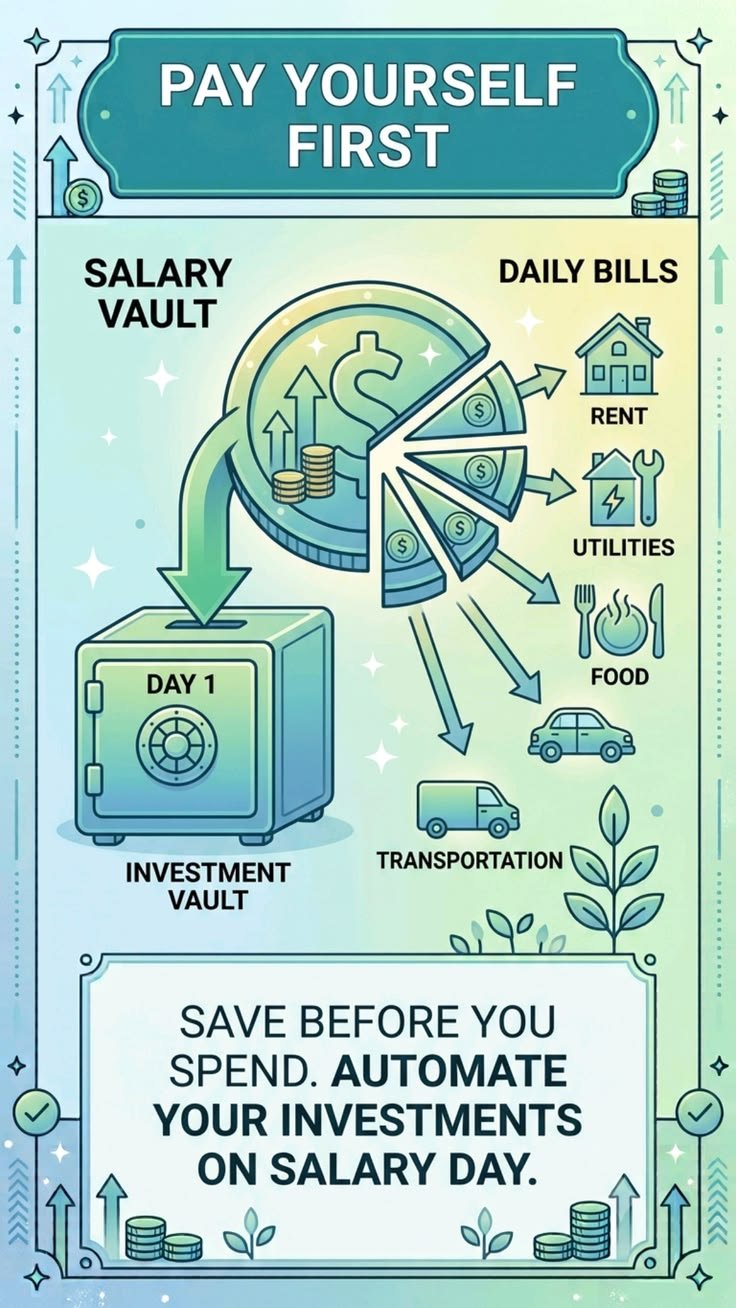
2. Pay Yourself First Before Spending Your Salary
One common financial mistake is waiting until the end of the month to save whatever money remains. Unfortunately, many people discover that nothing is left after paying bills and handling everyday expenses.
A smarter approach is to pay yourself first.
This means treating savings and investments as important financial responsibilities rather than optional activities. As soon as your salary arrives, transfer a predetermined amount into your savings or investment accounts.
For example, if you receive $2,800 monthly, you could automatically transfer $280 into savings and another $140 into an investment account, provided your emergency savings and financial obligations are appropriately managed.
Starting with even 5% or 10% of your income can make a meaningful difference over time.
You do not have to begin with a large amount. Consistency matters more than perfection. As your income increases, gradually increase the amount you save and invest.
3. Build an Emergency Fund to Protect Your Financial Progress
Unexpected expenses can destroy months of financial progress when you are not prepared.
Imagine losing your job, facing an expensive car repair, receiving an unexpected medical bill, or dealing with an urgent household problem. Without emergency savings, you might have to borrow money, use credit cards, or withdraw investments at an inconvenient time.
An emergency fund provides a financial cushion when life does not go according to plan.
A reasonable long-term target is three to six months of essential living expenses. If your income is irregular or you support several family members, you may want a larger cushion.
However, do not allow the size of this goal to discourage you. Start with a smaller target, such as $500 or $1,000, and build gradually.
Keep emergency money in an accessible, interest-bearing savings account rather than investing it in assets that can lose value.
Remember, an emergency fund is not designed to make you rich. Its purpose is to prevent unexpected problems from pushing you into debt and disrupting your wealth-building journey.
4. Invest a Portion of Your Salary Consistently
Saving money is important, but investing can help your wealth grow over the long term.
Money sitting in a regular savings account may earn interest, but inflation can reduce its purchasing power over time. Investing provides an opportunity to grow your money, although it also involves risks and the possibility of losing some or all of your investment.
Consider learning about diversified investments such as broad-market index funds, exchange-traded funds (ETFs), and other investments appropriate for your financial goals and risk tolerance.
For example, investing $200 every month may seem insignificant at first. However, consistent contributions over many years can potentially become substantial through investment growth and compounding.
Suppose you invest $200 monthly for 25 years and earn an average annual return of 7%, compounded monthly. You could accumulate approximately $162,000 before taxes and fees.
This is an illustration, not a guaranteed return. Actual investment performance varies, and markets can experience significant losses.
The important lesson is to start with an amount you can afford, understand what you are investing in, diversify appropriately, and remain focused on your long-term goals.
5. Avoid Lifestyle Inflation When Your Salary Increases
Receiving a salary increase is exciting. It can make life more comfortable and create opportunities to improve your financial situation.
However, one hidden danger is lifestyle inflation.
Lifestyle inflation happens when your spending increases whenever your income increases. You receive a raise, purchase a more expensive vehicle, move into a more expensive apartment, upgrade your lifestyle, and gradually spend nearly everything you earn.
As a result, your income increases, but your financial position barely improves.
A better strategy is to increase your savings and investments whenever your salary increases.
For example, if your employer gives you a $400 monthly raise, consider directing $250 toward investments or savings and using the remaining $150 to improve your lifestyle.
This approach allows you to enjoy the rewards of your hard work while accelerating your wealth-building journey.
You do not need to live an unnecessarily restrictive life. The goal is to ensure that higher earnings translate into greater financial security.
6. Eliminate High-Interest Debt as Quickly as Possible
Debt can become one of the biggest obstacles to building long-term wealth, particularly when it carries high interest rates.
Credit card balances, payday loans, and other expensive borrowing arrangements can consume a significant portion of your monthly salary.
For example, carrying a $5,000 credit card balance with a high interest rate can become extremely expensive if you only make minimum payments.
Instead of allowing interest charges to consume your income, develop a clear debt repayment strategy.
Two popular methods include:
The debt avalanche method: Focus on paying off the debt with the highest interest rate first while making minimum payments on the others. This generally minimizes total interest costs.
The debt snowball method: Pay off the smallest debt first while maintaining minimum payments on the others. This can provide motivation through quick wins.
Choose the approach that helps you remain consistent.
Once high-interest debt is eliminated, redirect the money previously used for debt payments toward savings and investments.
7. Develop Multiple Sources of Income
Depending entirely on one monthly salary can make your financial future vulnerable.
If your employer reduces your working hours, your company experiences financial difficulties, or you lose your job, your entire income may disappear.
Developing additional income sources can reduce this risk and create more opportunities for wealth building.
Depending on your skills and interests, you could explore:
- Freelance writing and editing.
- Graphic design and digital services.
- Online tutoring.
- Consulting.
- Selling digital products.
- Starting a small online business.
- Rental property income, where financially appropriate.
- Creating educational content.
You do not need to pursue every opportunity at once. Start with one additional income stream that fits your schedule and abilities.
The smartest approach is to avoid spending all the extra money you earn. Consider directing a meaningful portion toward debt repayment, emergency savings, and long-term investments.
Over time, additional income can make it easier to achieve financial goals that might be difficult with your salary alone.
8. Set Clear Financial Goals and Give Your Money Direction
It is difficult to build wealth when you do not know what you are working toward.
Saving money without a specific purpose can make it tempting to withdraw funds whenever an attractive purchase appears.
Instead, establish clear financial goals.
Your goals might include:
- Saving $10,000 for an emergency fund.
- Paying off all high-interest debt.
- Saving for a home down payment.
- Building an investment portfolio.
- Starting a profitable business.
- Saving for your children’s education.
- Preparing for retirement.
Give every goal a realistic deadline and determine how much money you need to contribute each month.
For instance, if you want to save $6,000 over two years, you need to put aside approximately $250 monthly, excluding any interest earned.
Breaking large goals into smaller monthly contributions makes financial progress easier to understand and maintain.
9. Take Advantage of Employer Retirement Benefits
If your employer offers retirement benefits, make sure you understand how they work.
Some employers provide retirement contribution matching. This means the company contributes additional money to your retirement account when you contribute a certain amount yourself.
For example, an employer might match 50% of your contributions up to a specified percentage of your salary.
If you qualify, taking advantage of the full available match can significantly improve your retirement savings.
In the United States, workplace retirement accounts such as 401(k) plans may offer tax advantages depending on whether contributions are traditional or Roth.
You can also explore individual retirement accounts (IRAs), including traditional and Roth IRAs, depending on your eligibility and circumstances.
Understand the contribution limits, withdrawal rules, investment choices, fees, and tax implications before making decisions.
Retirement planning is not something that should begin when you are close to retirement. Starting early gives your investments more time to potentially benefit from compounding.
10. Control Unnecessary Spending and Stop Emotional Shopping
Sometimes, the biggest threat to your financial progress is not a low salary. It is spending money on things that provide temporary excitement but little long-term value.
Online shopping, expensive subscriptions, frequent restaurant visits, impulse purchases, and unnecessary upgrades can gradually consume your income.
This does not mean you should stop enjoying life. Instead, learn to recognize the difference between spending that improves your quality of life and spending driven by temporary emotions.
One helpful technique is the 24-hour rule.
Whenever you want to purchase something that is not essential, wait at least 24 hours before making the decision. For larger purchases, consider waiting several days.
This gives you time to decide whether you genuinely need the item or simply want it because of a temporary feeling.
Review your bank statements regularly and identify expenses that can be reduced or eliminated.
Even saving $50 or $100 monthly by controlling unnecessary spending can provide additional money for investments and financial goals.
11. Invest in Skills That Can Increase Your Earning Potential
Your ability to earn money is one of your most valuable financial assets.
While investing in stocks, property, and other assets can help grow wealth, investing in yourself can also create opportunities for higher income.
Consider developing skills that are valuable in your industry or the wider job market.
These might include:
- Digital marketing.
- Financial analysis.
- Project management.
- Software development.
- Data analysis.
- Communication and leadership.
- Sales and business development.
- Artificial intelligence tools and practical technology skills.
You do not necessarily need an expensive degree to improve your abilities. Online courses, professional certifications, books, workshops, and practical experience can all contribute to your development.
The goal is to become more valuable in the marketplace.
When your skills improve, you may become better positioned to negotiate a salary increase, qualify for promotions, secure higher-paying employment, or start a profitable side business.
Your salary is not necessarily fixed forever. Continuous learning can help expand your financial opportunities.
12. Diversify Your Investments Instead of Depending on One Asset
One important principle of long-term wealth building is diversification.
Diversification means spreading your investments across different assets rather than placing all your money into a single investment.
For example, someone who invests their entire savings in one company’s stock could experience substantial losses if that company performs poorly.
A diversified portfolio might include different types of investments, such as:
- Broad-market stock funds.
- International stock funds.
- Bond funds.
- Cash and savings.
- Other suitable investments based on individual circumstances.
The right combination depends on your age, financial goals, investment timeline, and ability to tolerate market fluctuations.
Diversification does not eliminate investment risk or guarantee profits, but it can reduce the impact of poor performance from one particular investment.
Avoid investing your entire salary in opportunities simply because someone promises extraordinary returns.
Research carefully, understand the risks, and focus on building a balanced financial foundation.
13. Protect Your Wealth With Appropriate Insurance
Building wealth is important, but protecting what you have already achieved is equally important.
A single unexpected event can create serious financial problems if you do not have appropriate protection.
Depending on your circumstances, useful forms of insurance may include:
- Health insurance.
- Auto insurance.
- Renters or homeowners insurance.
- Disability insurance.
- Life insurance when others depend financially on you.
For example, someone who provides the primary income for a family may need life insurance to help protect their dependents if they pass away.
Similarly, disability insurance may help replace part of your income if an illness or injury prevents you from working, subject to the policy’s terms.
Review your coverage regularly to make sure it reflects your current responsibilities and financial situation.
Insurance should be viewed as part of a broader financial protection strategy, not simply another monthly expense.
14. Automate Your Savings and Investment Contributions
Building wealth requires consistency, but consistency can become difficult when you rely entirely on motivation.
Some months you may feel disciplined. Other months, unexpected expenses or personal desires may interfere with your financial plans.
Automation can make wealth building easier.
Set up automatic transfers from your checking account to your savings account shortly after payday. You can also arrange recurring investment contributions through a reputable financial institution or brokerage.
For example, you might automatically transfer:
- $150 into emergency savings.
- $200 into a long-term investment account.
- $100 toward a specific financial goal.
Adjust these amounts to fit your income and financial obligations.
Automation reduces the temptation to spend money that should be saved or invested.
It also creates a system where your financial progress continues even when you are busy with work, family, and everyday responsibilities.
15. Be Patient and Allow Compound Growth to Work for You
Perhaps the most powerful wealth-building principle is patience.
Many people want immediate financial success. They see stories of individuals making millions through businesses, investments, or online opportunities and begin searching for shortcuts.
However, sustainable wealth is often built through years of consistent financial decisions.
Compound growth occurs when the returns generated by an investment are reinvested and begin generating additional returns themselves.
Over time, this can create a snowball effect.
Consider someone who invests $300 every month for 30 years and earns an average annual return of 7%, compounded monthly. Their investment could grow to approximately $366,000 before taxes and fees.
The total amount contributed would be $108,000. The remaining growth would come from investment returns.
This example assumes a steady return that real markets do not provide. Actual results can be higher or lower, and losses are possible.
Nevertheless, it demonstrates why time and consistency are so valuable.
You do not need to make extraordinary financial decisions every month. You need to make sensible decisions repeatedly and give your money enough time to grow.
Final Thoughts: Your Monthly Salary Can Become the Foundation of Your Wealth
Building long-term wealth does not happen simply because you receive a paycheck. It happens because of the decisions you make after that money enters your account.
Your salary can either disappear through unnecessary spending or become the foundation of a stronger financial future. The difference often comes down to discipline, planning, patience, and consistency.
Start by creating a realistic budget, paying yourself first, building an emergency fund, and reducing expensive debt. Gradually introduce regular investing, develop additional income sources, improve your professional skills, and protect the financial progress you make.
Most importantly, do not compare your financial journey with someone else’s.
Someone earning $2,500 monthly who consistently saves and invests may eventually build greater financial security than someone earning $8,000 monthly but spending everything they receive.
Remember that wealth is not only about how much money you earn. It is also about how much you keep, how wisely you invest it, and how effectively you protect it.
You do not have to wait until you receive a promotion, start a business, or earn a six-figure salary before taking control of your finances.
Start with the salary you have today. Make a plan, take small steps, and remain committed to your goals.
Your monthly salary may be earned one month at a time, but the financial decisions you make today can create opportunities, security, and wealth that benefit you for the rest of your life.
