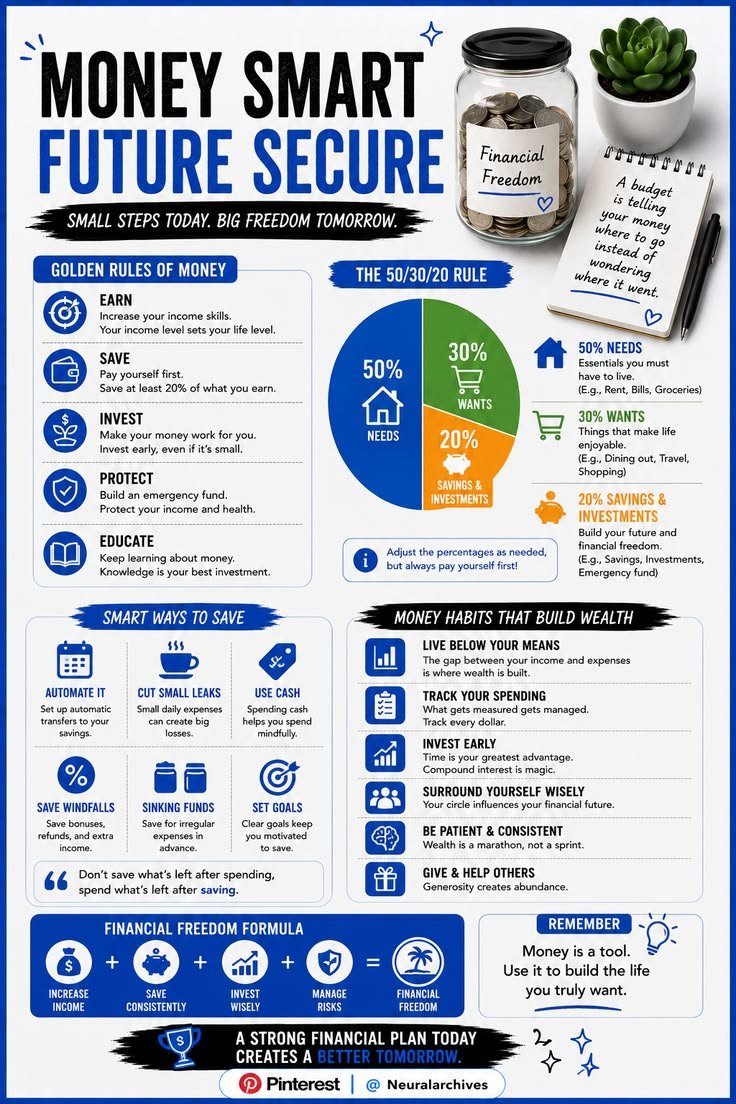
Financial security is one of the most important achievements anyone can work toward in life. It is not simply about having a large amount of money in your bank account, earning a six-figure salary, or owning expensive properties. True financial security means having the confidence that you can handle unexpected expenses, meet your daily needs, prepare for retirement, support your loved ones, and enjoy life without constantly worrying about money.
Many people work hard every day, earn regular incomes, and still struggle to achieve financial stability. Some spend more than they earn, others accumulate unnecessary debt, while many fail to plan for the future. The problem is not always how much money people make. Sometimes, it is how they manage the money they already have.
Building long-term financial security does not happen overnight. It requires discipline, patience, smart decision-making, and consistent financial habits. The good news is that you do not need to become wealthy before you can start building a secure financial future. Even with a modest income, you can make meaningful progress by taking control of your spending, saving consistently, investing wisely, and protecting yourself against financial risks.
The secret is to stop thinking only about your next paycheck and start making decisions that benefit your future.
In this guide, we will explore 15 powerful secrets to creating long-term financial security, helping you develop healthier money habits, build lasting wealth, and create a future where financial worries have less control over your life.
1. Create a Clear and Realistic Financial Plan
One of the most important secrets to achieving long-term financial security is having a financial plan. Without a clear direction, it becomes difficult to understand where your money is going, what you should prioritize, and how you can achieve your financial goals.
A financial plan gives your money a purpose. Instead of spending whatever you earn and hoping something remains at the end of the month, you create a strategy that guides your financial decisions.
Start by identifying your most important financial goals. You might want to pay off debt, purchase a home, build an emergency fund, invest for retirement, or save enough money to start a business.
Once you understand your goals, break them into smaller and achievable steps. For example, if your goal is to save $12,000 within two years, you need to save approximately $500 every month.
Your financial plan should also include your monthly income, expenses, savings, investments, and outstanding debts.
Remember that a financial plan does not have to be complicated. What matters most is having a clear understanding of what you want to accomplish and consistently working toward it.
2. Always Spend Less Than You Earn
Spending less than you earn is one of the strongest foundations of financial security. No matter how much money you make, you will struggle financially if your expenses constantly exceed your income.
Many people increase their spending whenever they receive a salary increase, promotion, or unexpected financial bonus. They purchase more expensive clothes, upgrade their vehicles, move into larger homes, and increase their lifestyle expenses.
Although enjoying the rewards of hard work is important, constantly increasing your spending can prevent you from building wealth.
The smarter approach is to increase your savings and investments whenever your income grows.
For example, if you receive an additional $500 every month, consider putting a significant portion toward savings, debt repayment, or investments instead of immediately increasing your expenses.
Develop the habit of separating your needs from your wants. Housing, groceries, transportation, healthcare, and essential bills deserve priority. Expensive entertainment, unnecessary subscriptions, and impulse purchases should come after your financial responsibilities.
The money you consistently avoid spending can become the foundation of your future financial independence.
3. Build an Emergency Fund Before Financial Problems Appear
Life is unpredictable. Unexpected medical expenses, vehicle repairs, job losses, home maintenance problems, and family emergencies can happen when you least expect them.
Without emergency savings, even a relatively small financial problem can force you to borrow money, use credit cards, or interrupt your long-term financial plans.
An emergency fund provides protection against these unexpected situations.
A good starting point is to save your first $1,000 if your circumstances allow. After that, gradually work toward building enough money to cover three to six months of essential living expenses.
For example, if your necessary monthly expenses are $2,500, a fully funded emergency savings account could contain between $7,500 and $15,000.
Keep this money somewhere safe and accessible, such as an appropriate high-yield savings account. Avoid investing your emergency fund in risky assets because you may need to access the money during a market downturn.
The most important thing is to contribute consistently, even if you can only save a small amount each month.
An emergency fund is not money sitting around without purpose. It is financial protection that gives you breathing room when life becomes difficult.
4. Eliminate High-Interest Debt as Quickly as Possible
Debt can become one of the biggest obstacles to achieving long-term financial security.
Credit card balances, payday loans, and other high-interest debts can consume a significant portion of your income. Instead of using your money to build wealth, you may find yourself spending hundreds of dollars every month simply paying interest.
The longer high-interest debt remains unpaid, the more expensive it can become.
One effective strategy is the debt avalanche method. This approach involves making minimum payments on all your debts while directing additional money toward the debt with the highest interest rate.
Once that debt is eliminated, move the extra payment toward the next highest-interest balance.
Another option is the debt snowball method, which focuses on paying off the smallest balance first. This can provide psychological motivation because you experience smaller victories along the way.
Choose the strategy that helps you remain consistent.
Most importantly, avoid accumulating new unnecessary debt while trying to eliminate existing balances.
Becoming debt-free does not automatically make someone wealthy, but reducing expensive debt creates more opportunities to save, invest, and build financial stability.
5. Make Saving Money a Non-Negotiable Habit
One of the biggest mistakes people make is waiting until the end of the month to save whatever money remains.
Unfortunately, many people discover that there is nothing left because their spending has already consumed their income.
A better strategy is to pay yourself first.
This means setting aside a portion of your income for savings immediately after receiving your paycheck.
You can begin with 5% or 10% of your income and gradually increase the amount as your financial situation improves.
For example, someone earning $4,000 monthly could save $400 by putting aside 10% of their income.
Automating your savings makes the process easier. Set up an automatic transfer from your checking account to your savings account so that saving becomes part of your regular financial routine.
Do not underestimate small contributions. Saving $50 or $100 consistently can make a meaningful difference over time.
The goal is not to save everything you earn. It is to develop a reliable habit that allows your savings to grow without requiring constant motivation.
6. Invest Early and Take Advantage of Compound Growth
Saving money is important, but investing can help you build wealth over the long term.
One of the most powerful principles in personal finance is compound growth. This happens when your investment earnings generate additional earnings over time.
In simple terms, your money begins working for you instead of depending entirely on your ability to earn income.
For example, imagine investing $200 every month for 30 years and earning an average annual return of 7%, compounded monthly. You could accumulate approximately $244,000, assuming consistent contributions and no withdrawals.
Your total contributions would be $72,000, while the remaining amount would come from investment growth.
Illustrative example only. A 7% return is not guaranteed; actual investment returns fluctuate, and fees, taxes, and inflation affect results.
Consider learning about diversified investments such as low-cost index funds, exchange-traded funds (ETFs), and retirement accounts.
In the United States, accounts such as 401(k)s and IRAs may provide useful retirement investment and tax advantages, depending on eligibility and circumstances.
The earlier you begin investing, the more time your money has to potentially grow.
You do not need to start with thousands of dollars. Consistency and a long-term mindset are often more important than making large investments immediately.
7. Never Depend on a Single Source of Income
Relying entirely on one source of income can create financial vulnerability.
If you lose your job, experience reduced working hours, or encounter difficulties in your industry, your entire financial situation could be affected.
Developing additional income sources can provide greater financial flexibility and reduce your dependence on a single paycheck.
There are several ways to build additional income, including:
- Freelancing using your professional skills.
- Starting an online business.
- Creating digital products.
- Offering consulting services.
- Building a profitable blog or educational website.
- Investing in income-producing assets.
- Developing a side business around a skill you already possess.
However, remember that additional income requires time, effort, and sometimes an initial investment.
Avoid opportunities that promise guaranteed profits or unrealistic returns.
Start with something manageable. Even an additional $200 or $300 per month can help you pay off debt faster, increase your savings, or invest more consistently.
Over time, multiple income sources can strengthen your financial position and provide greater peace of mind.
8. Protect Your Wealth With Proper Insurance
Building wealth is important, but protecting what you have already achieved is equally essential.
Imagine spending years saving money, purchasing a home, and building investments, only to experience a major accident or unexpected health problem that creates enormous financial expenses.
Without appropriate protection, one unexpected event could damage years of financial progress.
Insurance helps reduce the financial impact of certain risks.
Depending on your circumstances, consider evaluating:
- Health insurance: Helps cover eligible medical expenses.
- Life insurance: Can provide financial support to beneficiaries after your death.
- Auto insurance: Helps protect against covered vehicle-related losses.
- Homeowners or renters insurance: Helps protect your property and belongings against covered risks.
- Disability insurance: Can replace part of your income if a qualifying disability prevents you from working.
- Long-term care insurance: May help cover certain extended care expenses.
You do not need every insurance product available. The important thing is to identify the risks that could seriously damage your financial future and select appropriate coverage.
Review your policies regularly to ensure that your protection remains suitable as your responsibilities change.
9. Develop Financial Literacy and Improve Your Money Knowledge
Financial knowledge can change the way you make decisions.
Many people work for decades without understanding important financial concepts such as interest rates, inflation, investment risk, taxes, retirement planning, and credit management.
This lack of knowledge can lead to expensive mistakes.
Financial literacy helps you understand how money works and how different decisions affect your future.
Make time to learn about budgeting, saving, investing, borrowing, and wealth management.
You can improve your knowledge by reading reputable financial books, following trustworthy financial educators, attending educational workshops, and studying reliable personal finance resources.
Learn how credit scores work, how compound interest affects borrowing and investing, and how inflation influences purchasing power.
You should also understand the difference between good financial opportunities and misleading promises.
The more you understand money, the more confident you become when making important financial decisions.
Remember that financial education is not something you complete once. It is a lifelong process that becomes increasingly valuable as your income, responsibilities, and financial goals evolve.
10. Set Clear Retirement Goals and Prepare Early
Retirement may seem far away, especially when you are focused on paying bills, supporting your family, and managing everyday responsibilities.
However, delaying retirement planning can make it more difficult to achieve financial independence later in life.
The earlier you begin preparing, the more time you have to build your retirement savings.
Start by estimating how much money you may need during retirement. Consider your expected housing expenses, healthcare costs, transportation, food, travel, and other lifestyle needs.
If your employer offers a 401(k) retirement plan with matching contributions, understand the matching arrangement and consider contributing enough to receive the full available match if financially practical.
You can also explore traditional and Roth IRAs, depending on your eligibility and financial circumstances.
Review your retirement contributions periodically and increase them when your income allows.
Do not assume that Social Security alone will provide everything you need during retirement.
The goal is to build several sources of retirement support so that you can enjoy your later years without depending entirely on your next paycheck.
11. Control Lifestyle Inflation as Your Income Increases
Lifestyle inflation happens when your spending increases as your income grows.
For example, someone earning $3,000 per month may manage their expenses comfortably. After receiving a promotion and earning $5,000 monthly, they may immediately purchase a more expensive vehicle, upgrade their home, and increase entertainment spending.
Although their income has increased, their ability to save may remain unchanged.
This is one reason some high-income earners struggle financially despite earning significantly more than the average worker.
The secret is to avoid allowing every income increase to become a spending increase.
Whenever you receive a raise, bonus, or additional income, direct part of the increase toward financial goals.
You can reward yourself occasionally without sacrificing your future.
For example, consider allocating 50% of an income increase toward savings, investments, or debt repayment while using the remaining portion to improve your lifestyle.
The exact percentage depends on your situation.
Financial security is not about refusing to enjoy your money. It is about finding a healthy balance between enjoying today and preparing for tomorrow.
12. Monitor Your Spending and Review Your Financial Progress
You cannot effectively manage your finances if you do not understand where your money goes.
Small expenses can quietly become major financial leaks.
A daily coffee, unused subscription, frequent restaurant visit, or unnecessary online purchase may appear insignificant individually. However, when repeated over months and years, these expenses can consume a considerable amount of money.
Start tracking your income and expenses.
You can use a budgeting application, spreadsheet, notebook, or simple banking tools to monitor your financial activity.
Organize your expenses into categories such as:
- Housing and utilities.
- Groceries and household essentials.
- Transportation.
- Healthcare.
- Debt payments.
- Entertainment.
- Savings and investments.
At the end of each month, review your spending and identify areas where you can make improvements.
Ask yourself whether your expenses reflect your priorities.
If you discover that you are spending too much on unnecessary purchases, make adjustments rather than blaming yourself.
Financial progress comes from understanding your habits and improving them gradually.
13. Avoid Emotional Spending and Make Thoughtful Financial Decisions
Money decisions are not always based on logic. Sometimes, emotions influence how people spend, save, borrow, and invest.
Stress, excitement, social pressure, boredom, and fear can encourage poor financial decisions.
For example, someone may purchase an expensive phone simply because their friends have newer devices. Another person may invest in a trending asset because they are afraid of missing an opportunity.
These decisions can create unnecessary financial problems.
Develop the habit of pausing before making significant purchases.
Give yourself 24 to 48 hours to consider whether an expensive item is genuinely necessary.
Before buying something, ask yourself:
- Do I really need this?
- Can I comfortably afford it?
- Will this purchase affect my savings goals?
- Am I buying it because I need it or because I feel pressured?
- Could this money serve a more important financial purpose?
When investing, avoid allowing fear and excitement to control your decisions.
Understand what you are investing in, the risks involved, and how it fits into your long-term strategy.
A financially secure person does not make every decision perfectly. Instead, they develop habits that reduce unnecessary mistakes.
14. Protect Yourself Against Inflation and the Rising Cost of Living
Inflation is one of the biggest long-term challenges facing anyone trying to maintain financial security.
It reduces purchasing power by increasing the prices of goods and services over time.
For example, if your savings earn 2% annually while inflation averages 4%, your money loses purchasing power in real terms.
This means that simply keeping all your money in a regular savings account may not be enough to preserve your long-term wealth.
To protect your financial future, consider combining accessible savings with appropriate long-term investments.
Depending on your circumstances and risk tolerance, you may explore:
- Diversified stock market investments.
- Treasury inflation-protected securities (TIPS).
- High-yield savings accounts for short-term cash.
- Diversified bond investments.
- Real estate investments where suitable.
Each investment carries different risks, costs, and potential returns.
Avoid putting all your money into one asset simply because it has performed well recently.
Diversification can help reduce the impact of poor performance in any single investment.
The most important lesson is to understand that financial security requires protecting not only the amount of money you have but also what that money can purchase in the future.
15. Build Generational Wealth and Think Beyond Yourself
The final secret to creating long-term financial security is to develop a mindset that extends beyond your immediate needs.
Financial success becomes even more meaningful when it creates opportunities for the people you care about and future generations.
Generational wealth is not limited to wealthy families. Ordinary individuals can begin building a financial foundation that benefits their children and loved ones.
Start by developing healthy financial habits that your family can learn from.
Teach children the importance of saving, budgeting, responsible borrowing, and investing.
As your financial position improves, consider building assets that may provide lasting value, such as retirement investments, property, business ownership, or other appropriate investments.
You should also organize important financial documents, maintain an updated estate plan, and consider appropriate beneficiary arrangements.
A will, trusts where suitable, and clear instructions can help make it easier for your loved ones to understand your wishes.
Remember that generational wealth is not only about leaving money behind. It is also about passing down financial knowledge, good decision-making habits, and opportunities.
The strongest financial legacy is one that prepares the next generation to manage money responsibly rather than simply giving them money to spend.
Additional Financial Habits That Strengthen Long-Term Security
The 15 secrets discussed above provide a strong foundation, but achieving lasting financial security also requires consistency.
Here are several additional habits worth developing:
1. Review your financial goals every year. Your responsibilities and priorities may change, so your financial strategy should evolve accordingly.
2. Maintain a healthy credit profile. Pay bills on time, monitor your credit reports, and avoid borrowing more than you can comfortably repay.
3. Negotiate major expenses. Review insurance premiums, phone plans, service subscriptions, and other recurring expenses to identify potential savings.
4. Invest in your professional development. Learning valuable skills can improve your earning potential and create new career opportunities.
5. Avoid unnecessary financial comparisons. Do not allow other people’s lifestyles to determine how you spend your money.
6. Keep your financial documents organized. Maintain records of important accounts, insurance policies, investments, debts, and estate planning documents.
7. Be patient with your progress. Building wealth takes time. Focus on consistent improvement instead of expecting overnight results.
Conclusion: Your Financial Future Begins With the Decisions You Make Today
Creating long-term financial security is not about becoming rich overnight or finding a secret investment that guarantees extraordinary returns. It is about making thoughtful financial decisions repeatedly until they become part of your everyday lifestyle.
The 15 powerful secrets discussed in this article demonstrate that financial security begins with a strong foundation. Creating a realistic financial plan, spending less than you earn, building emergency savings, eliminating high-interest debt, investing consistently, protecting your assets, and preparing for retirement can gradually transform your financial future.
You do not need to implement every strategy at once.
Start with the areas that need the most attention. If you have no savings, begin building an emergency fund. If you are struggling with debt, create a repayment strategy. If you are earning money but not investing, learn about suitable long-term investment options.
Most importantly, remain consistent.
There will be months when unexpected expenses interrupt your plans. There may be times when your income decreases or your financial goals seem difficult to achieve. These challenges do not mean you have failed. They are reminders that financial security requires flexibility, patience, and continuous improvement.
Never underestimate the power of small financial decisions. Saving a little every month, avoiding unnecessary debt, investing regularly, and learning something new about money can create meaningful results over time.
Your financial future is shaped by the choices you make today. Instead of waiting for the perfect opportunity or a higher income, begin with what you already have.
Build wisely, spend intentionally, invest patiently, and protect what you earn.
True financial security is not simply having enough money to survive. It is having the freedom, confidence, and preparation to face life’s uncertainties while creating opportunities for yourself and the people you love.
Your journey toward lasting financial freedom starts with one smart decision at a time.
