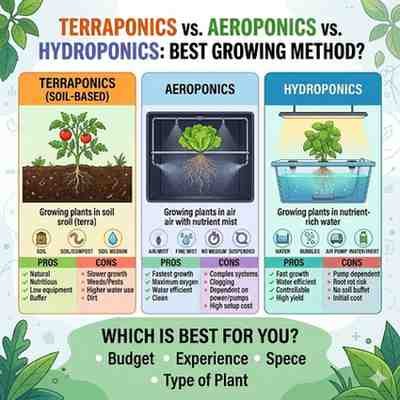
For decades, the biggest decision a gardener had to make was whether to plant seeds in the ground or in a raised bed. Today, the world of cultivation has exploded with innovative, soil-less techniques that promise faster growth, bigger yields, and the ability to grow food in the middle of a city or even the desert.
Among the most talked-about methods are hydroponics, aeroponics, and the lesser-known but equally intriguing terraponics. While they all fall under the umbrella of “soil-less” or “controlled environment” agriculture, they are fundamentally different in how they support and feed plants.
If you’re standing at the crossroads of modern gardening, wondering which path to take, this guide will break down the science, the pros and cons, and the “X-factors” of each method to help you find your perfect growing match.
The “Back to the Future” Contender: What is Terraponics?
Most gardeners are familiar with moving a plant from a small plastic pot to a larger one. Terraponics feels familiar because it starts that way. However, it is best described as a hybrid growing method that bridges the gap between traditional soil gardening and high-tech hydroponics .
How It Works
In a terraponic system, a plant is started in a small soil or soil-less potting mix. Once it has established a root ball, it is transplanted into a container filled with mineral pebbles, typically LECA (Lightweight Expanded Clay Aggregate) . The root ball stays intact, surrounded by soil in the center, but the plant is now sitting in a pot of inert clay pebbles. A water gauge or reservoir at the bottom allows the gardener to water from below, drawing the roots down into the pebbles over time .
The Unique Advantage
Terraponics offers a safety net that pure hydroponics does not. The original soil root ball acts as a buffer. If the power goes out or the water pump fails, the plant can draw moisture from the soil core for days, whereas a hydroponic plant might wilt within hours .
This method is gaining traction commercially as well. Companies like Terra Firma Foods are pioneering “NexGen™” terraponic farming to combine the organic benefits of soil with the efficiency of vertical farming, aiming to produce organic leafy greens with a smaller carbon footprint .
Best Suited For:
- Hobbyists transitioning from soil: It’s a low-stress way to dip your toes into soil-less growing.
- Organic purists: Because the plant starts in soil, it appeals to growers who want to maintain an organic medium.
- Stress-free vacationers: The buffer means your plants won’t die if you forget to water for a few extra days .
The Industry Standard: What is Hydroponics?
Hydroponics is the granddaddy of soil-less growing. If you’ve ever seen basil growing in a fancy kitchen appliance or a massive greenhouse producing tomatoes in the desert, you’ve seen hydroponics in action. The concept is simple: soil is replaced by a nutrient-rich water solution .
How It Works
Plant roots are supported by an inert medium (like coconut coir, perlite, or rockwool) or simply suspended directly into the water. The roots dangle into a reservoir where they absorb a precisely mixed “soup” of water and essential minerals . There are many variations, including:
- Deep Water Culture (DWC): Roots are submerged directly in the nutrient solution, with an air stone providing oxygen .
- Nutrient Film Technique (NFT): A shallow stream of water constantly flows over the roots .
- Dutch Buckets: Individual buckets filled with medium, great for larger plants like tomatoes or cucumbers .
The Unique Advantage
Hydroponics is incredibly forgiving compared to more advanced methods. The water in the system acts as a thermal battery, helping to moderate root temperatures. It also provides a buffer against human error; if you over-concentrate nutrients slightly, the water mass dilutes the impact .
According to the FAO, hydroponics is a game-changer for regions with poor soil quality, allowing year-round production in challenging climates, provided farmers have access to clean water and technical skills .
Best Suited For:
- Beginners in soil-less growing: It’s the easiest to learn and troubleshoot.
- Large plant cultivation: Systems like Dutch buckets are perfect for heavy feeders like squash and tomatoes .
- Budget-conscious growers: DIY hydroponic setups can be built with inexpensive materials like buckets and tubing .
The High-Performance Machine: What is Aeroponics?
If hydroponics is a reliable sedan, aeroponics is a Formula 1 race car. It is the most technologically advanced and efficient method, but it requires the most attention. In aeroponics, plant roots are suspended in mid-air and misted with a fine spray of nutrients .
How It Works
Plants are held in place by foam collars or net pots, sealing the top of a dark chamber. Inside the chamber, their roots hang freely. A timer activates a high-pressure pump that sprays the roots with an atomized mist—sometimes for just a few seconds every few minutes . This ensures the roots are never waterlogged and have 100% access to oxygen.
The Unique Advantage
Because the roots are exposed to air, they absorb oxygen at maximum efficiency. This oxygen saturation supercharges nutrient uptake, leading to explosive growth rates. NASA has experimented heavily with aeroponics, noting that it can reduce water usage by up to 98% compared to soil and drastically speeds up growth cycles—lettuce matures faster, and tomato seedlings are ready for transplant in days rather than weeks .
Furthermore, recent scientific reviews suggest that integrating plasma-activated water (PAW) into aeroponic misting could revolutionize nitrogen fixation and nutrient efficiency, solving some of the common deficiencies seen in standard systems .
Best Suited For:
- Space-limited growers: Vertical aeroponic towers pack the most plants into the smallest footprint .
- Speed demons: If you want the fastest possible harvest, this is it .
- Tech enthusiasts: Growers who love monitoring sensors, timers, and IoT devices will feel at home .
Head-to-Head: The Ultimate Comparison
To truly understand which method is “best,” you have to look at them side-by-side. The winner depends entirely on your personal goals, budget, and tolerance for risk.
Water and Nutrient Efficiency
- Aeroponics is the undisputed champion. By misting roots rather than bathing them, it uses up to 95% less water than traditional gardening and significantly less than hydroponics .
- Hydroponics is still a water miser compared to soil, recirculating water and reducing waste .
- Terraponics uses less water than soil but is less efficient than the other two because the soil core retains water that isn’t always available to the plant .
Complexity and Risk
- Terraponics is the lowest risk. The soil buffer protects against pump failures and power outages .
- Hydroponics offers a medium risk. While there is a buffer of water volume, equipment failure (like an air stone pump in a DWC system) can lead to rapid oxygen deprivation and root rot .
- Aeroponics is high risk, high reward. Because roots are exposed, if the misting cycle is interrupted for even a few hours, the roots dry out and die .
Oxygen Availability
- Aeroponics wins this category easily. Roots have unrestricted access to oxygen, which drives the rapid growth rates .
- Hydroponics still provides good oxygenation, especially in systems that aggressively bubble air through the water .
- Terraponics provides adequate oxygen, though the soil core can remain soggy if the grower doesn’t allow proper dry-back cycles .
Plant Health and Yield
- Aeroponics generally produces the highest quality plants with the fastest growth and densest trichome/resin development due to the sterile, high-oxygen environment .
- Hydroponics produces excellent yields and is very consistent, making it the global standard for commercial leafy greens .
- Terraponics aims for a different goal: flavor and organic integrity. By combining soil biology with controlled irrigation, proponents argue it produces “insect-free and soil-enhanced” organic food .
Making the Choice: Which One is Right for You?
So, how do you decide? Here is a simple guide based on your profile as a grower.
Choose Terraponics if…
You love the idea of soil but hate the mess. You want a sustainable, low-maintenance system that doesn’t require you to become a chemist. It is also the best choice if you want to grow organically using natural amendments, as the soil core supports microbial life that synthetic hydroponic nutrients cannot . Think of it as “smart soil” for the modern age.
Choose Hydroponics if…
You are looking for the best balance of cost, simplicity, and reliability. If you want to grow a wide variety of plants—from herbs to fruiting vegetables—without needing a degree in engineering, start here. It is the most documented method, meaning if something goes wrong, you can find a solution online in seconds. It is the ideal entry point for food security and learning the ropes of controlled environment agriculture .
Choose Aeroponics if…
You are a tinkerer and an optimizer. You don’t mind checking timers, cleaning misting nozzles, and maybe losing a crop while you learn. If your goal is to push the limits of plant growth and you have the budget for high-quality pumps and controllers, aeroponics is the most exciting frontier. It is the ultimate expression of efficiency, allowing you to grow the most food in the smallest space with the least water .
Conclusion
The “best” growing method doesn’t exist in a vacuum. Terraponics connects us to the traditional feel of gardening with a high-tech safety net. Hydroponics offers a democratic, accessible path to fresh, local food anywhere on the planet. Aeroponics represents the peak of agricultural technology, maximizing every drop of water and every photon of light.
Whichever you choose, you are stepping away from the uncertainties of open-field farming and into a world of precision and control. The future of food is not in the soil—it’s in the solution, the mist, and the pebbles. Happy growing

Umair Abdullah is a dedicated balcony gardening writer who helps urban growers cultivate vegetables, herbs, and plants in small spaces. He focuses on practical, beginner-friendly methods and shares tested tips to make balcony gardening simple, productive, and enjoyable.